



Muhalif Olmak – 2 | Being in Opposition 2


İnsan onuruna yakışmayacak, her türlü kirli işin ekonomi diye topluma yutturulduğu bir düzende yaşatılıyoruz.
Her türden sahteciliğin normal görüldüğü, emek harcamadan gelir elde etmenin takdir edildiği, çalışanın enayi sayıldığı, hukuksuzluğun hak olarak görüldüğü, üretenin batırıldığı, “ahlaksızlığın erdem olduğu” bu ada yarısında gerçekleri görüp de susmak, gerçekten çok acı vericidir.
Toplumsal kimliğimizin bozulması bilinçli yapılan bir siyasetin sonucudur. Eskiye özlem duyanlar, “biz eskiden böyle değildik” derken, 1974 sonrası Türkiye’nin dayattığı siyasi ortamın bozulmayı getirdiğini görmezden gelmektedirler.
Ganimet ve hırsızlığın meşru sayıldığı sahte bir düzende yaşadığımız hep göz ardı edilmektedir.
Maraş’ta yapılan soygun ve talanı bile övünerek “hüzün turizmi” adı altında sunan, kadın ticareti yapanlara “iş adamı” unvanı veren bu düzende, haksızlık, “hak” ve “hukuksuzluk” ise “adalet” olarak tanımlanmaktadır.
Haksızlığın hak olarak görülmesi bir kültürdür ve tarihsel kökleri Osmanlı coğrafyasında çok görülmekte, “kadı fıkralarına” bile konu yapılmakta veya tarihsel vakalarda yer almaktadır.
Bunun en güzel örneği “hoşafın yağı kesildi” olayıdır. Yeniçerileri ayaklandırıp, kazan kaldırmalarına neden olan olayda, yeniçeriler kendilerine yağsız hoşaf verilmesine kızıp mutfaktan sorumlu yeni paşanın kellesini isterler.
Bunun için de “hoşafın yağı kesildi” diye mutfaktaki kazanları devirip, sokaklarda olay çıkarırlar. Bilindiği üzere hoşaf kuru meyve ve şeker ile pişirilen, ana yemekten sonra yenen içinde yağ olmayan bir tatlıdır.
Olayı soruşturan yeniçeri ağası, etli, yağlı yemeklerin pişirildiği kazanların yıkanmadan, hoşaf pişirilmekte kullanıldığını öğrenir.
Bu pis kazanlardaki yağların hoşafa karıştığını ve uzun yıllar boyunca bu yemekleri yiyen yeniçerilerin hoşafı yağlı bir yiyecek olarak algılayıp, alıştıklarını saptar.
İsyana neden olan olay ise mutfaktan sorumlu ve kellesi istenen paşanın, mutfağa yaptığı baskınla bu pis kazanları yıkatıp, gerçek hoşaf pişirmesinden kaynaklanmaktadır.
Adamızın kuzeyinde de hukuksuzluğa alışmanın, yeniçerilerin pis kazanlarda pişen hoşafa alışmasından bir farkı yoktur. Osmanlı olmakla övünenlerin, rüşvet, adam kayırma, yolsuzluk, usulsüzlük, ganimet gibi pisliklere alışmaları ve bunu bir kültür olarak buraya taşımaları çok doğaldır.
Önemli olan ise kellesi uğruna, o pis kazanları yıkama cesaretini gösteren paşa gibi dik durarak, temiz kalma uğruna sistemin karşısına dikilip muhalefet edebilmektir.
Yıllardan beri çürük bir temel üstünde sağlam bir bina yapılamayacağını bile bile, hukuksuzluğu, normalleştirerek sunanların yarattığı bu düzende, haksızlıklar hak olarak görülmektedir.
Devlette işe alımlar yasayla belirlenmesine rağmen, her seçim dönemi öncesi yüzlerce kişi partizanlıkla “geçici işçi” adı altında istihdam edilerek, nitelikli insanları hakkı olan makamlar yandaşlarla doldurulmaktadır.
Son dönemde geçici işçi olarak işe alınanlara memurluk görevleri yaptırılmakta, bu da yetmezmiş gibi amirlik pozisyonlarına da getirilmektedirler.
Haksızca ve hukuk dışı yapılan bu uygulamalara karşı çıkanlara ise emek düşmanı damgası yapıştırılarak, hedef haline getirilmektedirler.
Uygulamaya karşı açıklama ve hukuksal girişim yapan sendikalar ise, usulsüzce işe alınan kişileri üye yaparak, ilkesel çelişkiler yaşamaktadırlar.
Okullardaki geçici öğretmen alımları da buna benzer bir uygulama olup, bugün geçici öğretmen sorununu “hak arayışı” olarak gören, eğitim bakanının, aslında bu sorunu yaratanların başında geldiğini vurgulamakta yarar görüyorum.
2010 yılında eğitim bakanı olan Nazım Çavuşoğlu ile yaptığımız temaslar sonucu geçici öğretmenlik uygulamasının kaldırılmasına yönelik Teknik Kurul ve Yüksek Danışma Kurulu toplantılarında uzlaşıya varmamıza ve yasal olarak varılan uzlaşıyı Bakanlar Kurulu ile meclise götürüp, yasallaştırması gerekmesine rağmen, bunu yapmayarak, bugün doğan sonucun çıkmasına neden olmuştur.
Şimdi de çıkıp, ahkam keserek, kendi suçunu gizlemeye ve “haksızlığı hak arama” olarak göstererek, bir umutla devlet kadrolarına girmeyi bekleyen yüzlerce geçici öğretmen üzerinden, oy uğruna siyaset yaparak, insanların duyguları ile oynamaktadır.
Bu gerçekler ortada iken, Kıbrıs Türk toplumunun varlığında çok önemli bir yere sahip Öğretmen Akademisi’nin ortadan kaldırılmasına yönelik Türkiye yetkililerinin yıllardan beri izlediği sistematik siyaset burada da devreye sokularak, geçici öğretmen sorunu bahane edilerek, öğretmen yetiştirme sistemi istismar edilmeye çalışılmaktadır.
KKTC’yi tanıtma bahanesi ile çocuklarımızı Türkiye’ye ölüme gönderen, Türkiye yetkililerine yağ çekme adına “türban” olayını dayatan, çocuklarımızı barakalarda eğitim almaya mahkûm eden, sahte diploma ve sahte bilimsel yayınların baş sorumlusu eğitim bakanına sesini çıkarmayan KTÖS yetkililerinin bugün ortaya çıkıp açıklama yapmalarının hiçbir değeri yoktur.
Atatürk Öğretmen Akademisi’ndeki belge olayında bu bakan UBP’li yönetim kurulunu görevden alırken neden sesinizi çıkarmadınız?
Yoksa üyeleriniz arasında para ile bilimsel yayın yaptım diye belge alıp, terfi alanların tepkisinden mi korktunuz?
Türkiye yetkililerinin tepkisinden korkarak, adamızın kuzeyine yapılan nüfus aktarımına ve kalabalık sınıfların oluşmasına karşı tek eylem yapmayan sendika, şimdi bakanı suçluyor ve bütün pis işlerin temizliğine vurgu yapmak için AÖA önüne çamaşır makinesi götürüyor.
Bu hükümeti ayakta tutanın Ankara’daki yönetim olduğunu bilmelerine rağmen uyum içinde, onu rahatsız etmeyip, suya sabuna dokunmadan hükümeti hedef alan muhalif görünüş, seçimlere yatırımdır.
Unutmayın ki, suya sabuna dokunmayanlar, temizlik yapamaz. Muhalefet etmek, tüm pis işleri bize hak ve hukuk olarak dayatan Ankara’daki yönetime karşı eylem yapmayı gerektirir.
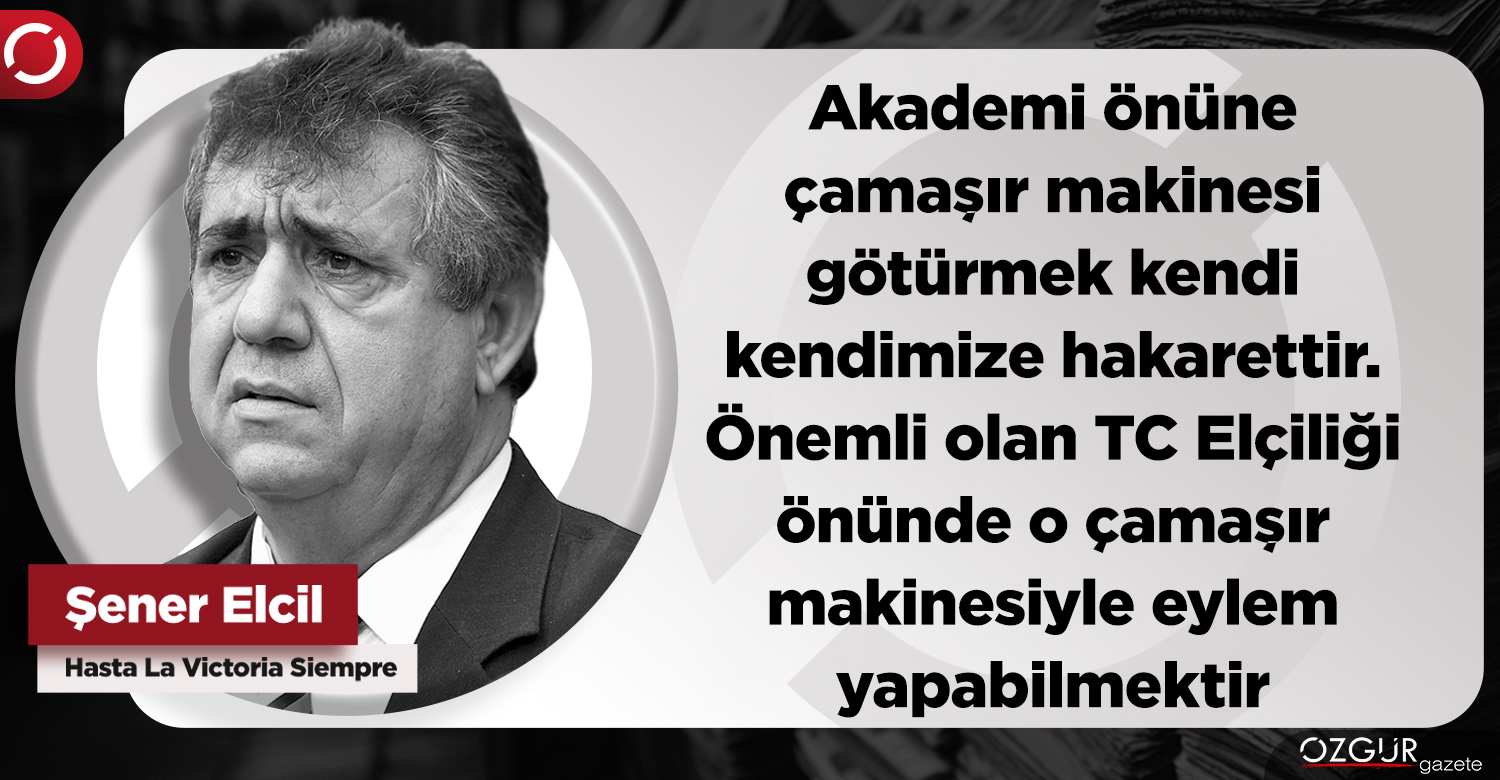
Atatürk Öğretmen Akademisi önüne çamaşır makinesi götürmek kendi kendimize hakaret etmektir. Önemli olan Ankara’nın temsilcisi olan TC Elçiliği önüne gidip o çamaşır makinesiyle eylem yapabilmektir.
***
Being in Opposition 2
We are being made to live in a system where every kind of dirty business, unworthy of human dignity, is sold to society under the name of “the economy”
In this half-island, where every form of fraud is considered normal, where earning income without labor is admired, where those who work are regarded as fools, where lawlessness is treated as a right, where those who produce are driven into ruin, and where “immorality is considered a virtue,” seeing these realities and remaining silent is truly painful.
The erosion of our social identity is the result of a deliberately pursued political agenda.
Those who nostalgically say, “We were not like this in the past,” ignore the fact that the political environment imposed by Turkey after 1974 has been a major cause of this degeneration.
It is consistently overlooked that we live in an artificial system where plunder and theft are regarded as legitimate. In this order, where the looting and pillaging of Varosha is proudly marketed as “grief tourism,” and those involved in human trafficking are honored with the title of “businessman,” injustice is redefined as “rights,” while lawlessness is presented as “justice.”
Accepting injustice as a right is itself a cultural phenomenon, one whose historical roots can be found throughout the Ottoman geography. It appears even in the famous “judge’s anecdotes” (kadı fıkraları) and numerous historical incidents.
One of the best examples is the story known as “The Oil Was Cut from the Compote.” The Janissaries revolted and overturned their cauldrons because they believed they had been served compote without oil, demanding the execution of the newly appointed pasha responsible for the kitchens.
Shouting that “the oil had been cut from the compote,” they overturned the kitchen cauldrons and rioted in the streets. Yet compote, as is well known, is a dessert made from dried fruits and sugar and contains no oil.
The Janissary commander who investigated the incident discovered that, for years, the cauldrons used to prepare greasy meat dishes had never been properly cleaned before being used to make compote.
As a result, grease from the filthy cauldrons had mixed into the dessert, and after eating it that way for so many years, the Janissaries had come to believe that compote was supposed to be oily.
The real reason for the uprising was that the pasha whose head they demanded had ordered the filthy cauldrons cleaned and had the compote prepared as it was actually meant to be.
There is little difference between becoming accustomed to lawlessness in the northern part of our island and the Janissaries becoming accustomed to oily compote cooked in filthy cauldrons. It is hardly surprising that those who take pride in their Ottoman heritage have grown accustomed to corruption, nepotism, bribery, irregularities, and the culture of plunder, carrying these habits here as well. What truly matters is having the courage to stand upright like the pasha who risked his life to clean those filthy cauldrons to remain clean and oppose the system despite the consequences.
For years, despite knowing full well that no solid building can stand on a rotten foundation, we have lived under a system created by those who normalize lawlessness.
In this order, injustice is accepted as a right. Although recruitment into public service is legally regulated, before every election hundreds of people are employed through partisan favoritism under the title of “temporary workers,” while positions that rightfully belong to qualified individuals are filled with political loyalists. More recently, temporary workers have been assigned civil service duties and, as if that were not enough, promoted into supervisory positions.
Those who object to these unlawful and unjust practices are branded as enemies of labor and turned into targets. Meanwhile, trade unions that issue statements and pursue legal action against these practices often end up enrolling these improperly recruited individuals as members, creating profound contradictions in their own principles.
The recruitment of temporary teachers in schools is another example of the same practice. Today, while the Minister of Education portrays the issue of temporary teachers as a matter of “defending rights,” it is worth emphasizing that he himself was among those primarily responsible for creating this problem.
Following our meetings with Nazım Çavuşoğlu, then Minister of Education in 2010, we reached consensus in both the Technical Committee and the Higher Advisory Council to abolish the practice of temporary teaching. Although the minister was legally obliged to submit this agreement to the Council of Ministers and Parliament for legislation, he failed to do so, directly contributing to the situation we face today.
Now, he seeks to conceal his own responsibility by portraying injustice as a struggle for rights, exploiting the hopes of hundreds of temporary teachers waiting for permanent public positions in order to gain votes, while manipulating people’s emotions.
Despite these realities, the long-standing systematic policy pursued by Turkish authorities to eliminate the Teachers’ Academy a cornerstone institution of the Turkish Cypriot community is once again being put into practice. This time, the issue of temporary teachers is being used as a pretext to undermine and exploit the teacher training system.
Those who sent our children to Turkey under the pretext of promoting the TRNC, only for them to lose their lives; those who imposed the headscarf controversy merely to curry favor with Turkish authorities; those who condemned our children to receive education in prefabricated classrooms; and those who remained silent in the face of the Minister of Education, who bears primary responsibility for fake diplomas and fraudulent academic publications statements issued today by officials of KTÖS carry no credibility.
When this minister dismissed the UBP-appointed Board of Directors of Atatürk Teachers Academy over the document scandal, why did you remain silent?
Or were you afraid of the reaction from members who had received promotions after obtaining certificates through paid-for academic publications?
The union that never organized a single protest against the population transfer to the northern part of the island fearing the reaction of Turkish authorities and against the resulting overcrowded classrooms, now blames the minister and brings a washing machine in front of the Teachers’ Academy to symbolize the need to clean up all the dirty affairs.
Although they know full well that this government survives only because of the administration in Ankara, presenting themselves as opponents while carefully avoiding any action that might disturb Ankara, and criticizing only the local government without touching the real source of the problem, is nothing more than an investment in future elections.
Remember: those who refuse to touch water and soap cannot clean anything. Genuine opposition requires standing against the administration in Ankara that imposes all these injustices upon us as if they were rights and the rule of law. Taking a washing machine to the Atatürk Teachers Academy is an insult to ourselves. What truly matters is having the courage to take that washing machine to the Turkish Embassy, the representative of Ankara, and protest there.